Architecture
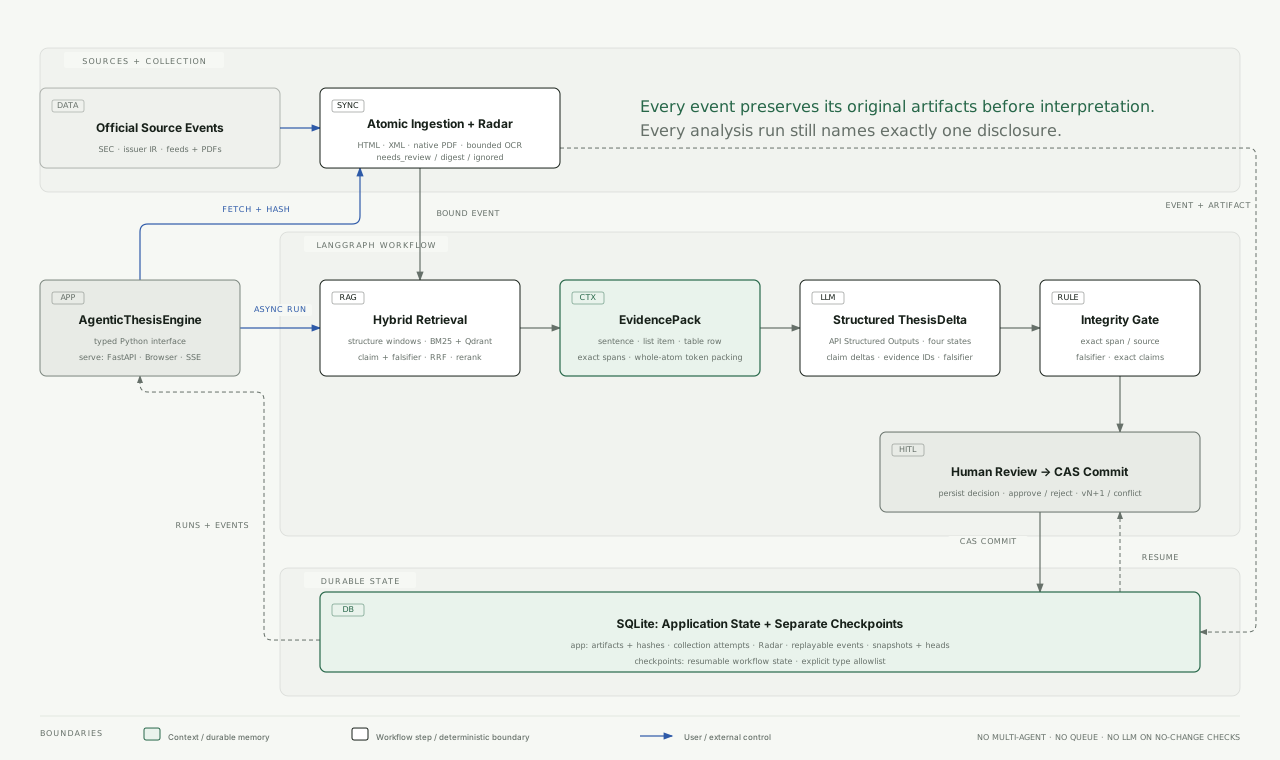
The editable diagram is available as a standalone HTML source.
In v1.1, collection registers an analysis run only for a needs_review event with a usable disclosure; digest and ignored events remain in Radar without starting analysis. Each run is bound to one disclosure.
Responsibility boundaries
Section titled “Responsibility boundaries”| Layer | Responsibility |
|---|---|
| Collection | Discover configured SEC/IR events and preserve exact artifacts before interpretation |
| Parsing | Produce stable, source-addressable sentence, list-item, table-row, and PDF-page spans |
| Radar | Deterministically decide whether an event needs review, belongs in a digest, or is ignored |
| Retrieval | Combine lexical and vector candidates, rerank conditionally, and pack bounded evidence |
| Analysis | Produce a typed claim-by-claim ThesisDelta from supplied evidence only |
| Integrity | Validate evidence IDs, exact quotes, offsets, claims, and falsifiers |
| Review | Pause for the investor to approve, edit, or reject the proposed change |
| Commit | Apply an approved delta only when its base thesis version is still current |
Storage roles
Section titled “Storage roles”- Application SQLite is the authoritative record for events, artifacts, Radar, runs, thesis heads, snapshots, and revisions.
- Checkpoint SQLite holds resumable LangGraph execution state separately from application transactions.
- Embedded Qdrant stores vectors for local retrieval and can be rebuilt from canonical chunks.
- Raw artifact bytes and hashes make every accepted quote traceable to the fetched source version.
IR change detection fingerprints normalized visible content so dynamic scripts do not generate duplicate disclosures; the stored artifact hash still identifies the original bytes. Vector indexing, retrieval queries, and analysis have explicit timeouts. Checkpoint recovery uses an explicit deserialization allowlist for workflow types.
Why one workflow
Section titled “Why one workflow”AgenticThesis has one application-owned LangGraph with six explicit state transitions. It is not a collection of autonomous agents. Retrieval, validation, commits, and conflict protection remain deterministic; models are restricted to embeddings, conditional reranking, and structured comparison.
This keeps Context, Memory, and Workflow State distinct:
- Context is the temporary, query-conditioned evidence supplied for one claim.
- Memory is the approved, immutable thesis snapshot and revision history.
- Workflow State is the recoverable execution record for an active or reviewed run.
Source boundary
Section titled “Source boundary”SEC and issuer-owned artifacts may become authoritative evidence. Secondary sources can propose a lead but cannot independently authorize a revision. The model cannot promote a lower-authority source by describing it as official.